
Buzz Cut at Home vs. Barber: A First-Cut Decision Guide
Decide whether to get a first buzz cut at home or with a barber by comparing visibility, guard length, fades, cleanup, recovery, and a low-risk plan.

For a first buzz cut, choose a barber when you want a fade, taper, sharp neckline, or help choosing the length. A simple one-length home buzz can work when you already know the guard you like, can see the back of your head with two mirrors, and are comfortable accepting an even—not highly detailed—finish. Before either route, use a buzz cut filter to judge the short silhouette on your own face.
Last updated: September 10, 2026 · about 7 min read
The short answer: match the route to the cut
This guide follows a different question from Should I Get a Buzz Cut?. That article is about whether the look suits your face, hairline, and maintenance preferences. This one begins after that decision: who should perform the first cut, and what level of finish are you actually asking for?
An all-over clipper cut is possible at home. The hard part is not the top; it is seeing the back, keeping every pass even, and knowing when a “simple buzz” has quietly become a fade, taper, or edge-up. A barber adds visibility and technical control, but the right answer is not automatically “professional” for every maintenance trim.
| Your situation | Better first choice | Why |
|---|---|---|
| You want one guard all over and have done it before | Home can be reasonable | The goal is simple and repeatable |
| This is your first major cut from longer hair | Barber | You can discuss length before the first pass and get help with the back |
| You want a fade, taper, lineup, or shaped neckline | Barber | These details depend on clean transitions and symmetry |
| You cannot set up two mirrors or ask someone to check | Barber | Missed patches and uneven necklines are hard to judge alone |
| You only need to keep an existing, plain buzz tidy | Home can be reasonable | You already know the approximate length and shape |
Do not start with the shortest guard you can imagine liking. Clippers remove length immediately; a second pass can always go shorter.
What makes a home buzz cut manageable
Home is most forgiving when the instruction is genuinely plain: one guard, dry hair, slow overlapping passes, and a stop to inspect the result. It becomes less forgiving when you need a polished outline around the ears and neck or different lengths that blend into one another.
Before you decide, make a small readiness check:
- You have clean clippers, a complete guard set, good light, and enough time to move slowly.
- You can see the back with two mirrors, or a trusted person can check it before you finish.
- You are comfortable with an even length and do not expect a self-cut to create a sharp fade by accident.
- You know the guard system for your own clippers. Guard labels and lengths are not interchangeable across every maker.
- You have chosen a length by previewing it, not by copying a label from someone else’s haircut.
The Wahl Home Products tutorial on a basic home buzz cut is a relevant manufacturer walkthrough for the one-length process, but it does not replace seeing your own crown and neckline.
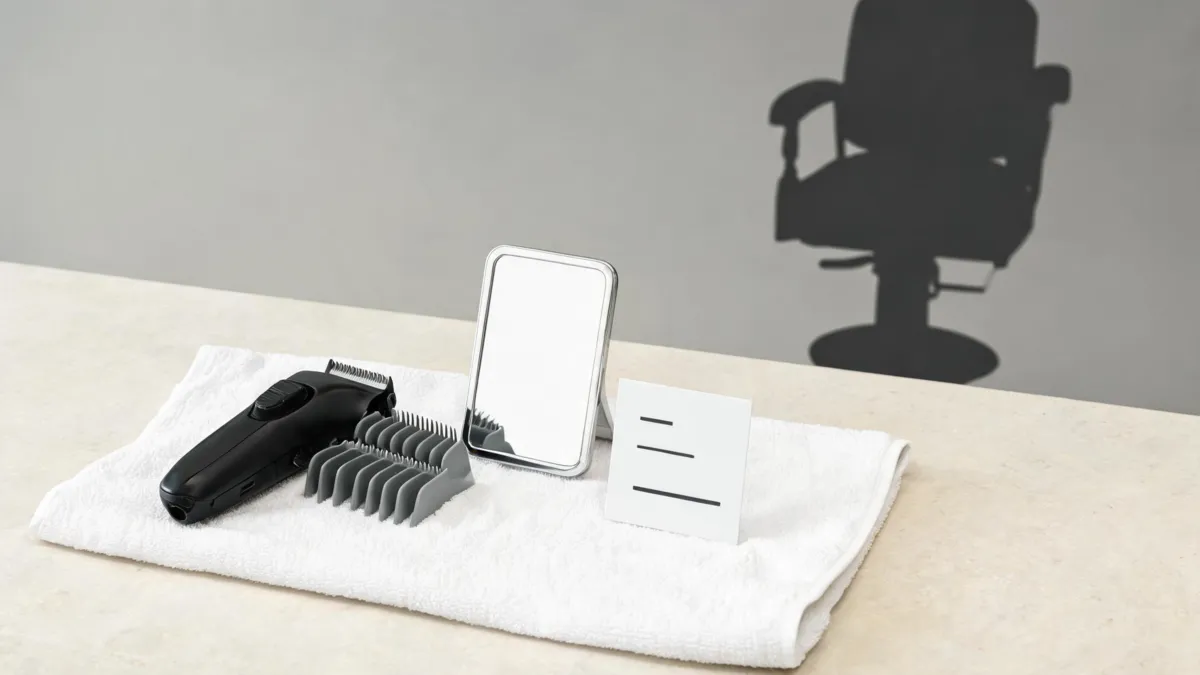
A simple home setup needs a clear view of the back; a barber is most valuable when shape and detail matter.
When a barber earns the extra trip
A barber is not only for complicated styles. It is a sensible first stop if going short feels like a big change, because you can talk through guard length, hairline exposure, and what happens at the crown before the length comes off. It is also the safer route for a cut that includes a fade, taper, hard edge, beard blend, or a neckline you want to look deliberate from behind.
Bring a small brief rather than an instruction copied from a comment thread. Say what you want to keep, what you are nervous about, and whether you want one even length or more shape at the sides. A saved buzz cut filter preview can help communicate the overall direction, but be clear that it is a reference—not a measurement.
For someone who plans to keep a short, simple buzz, there is a middle path: get the first cut and outline professionally, then do conservative at-home maintenance between visits. That approach lets you learn the length and shape you like without making the back of your head your first technical project.
Guard length, visibility, and error recovery
The most useful home rule is to begin long and evaluate. If you are between two guards, start with the longer one, make an even pass, inspect in good light, and only then decide whether to reduce the length. The same goes for a barber: ask to see the direction at a longer length before committing to a very close cut if you are uncertain.
Visibility is the other decision point. The crown can grow in a different direction than the sides, and the back is difficult to inspect alone. A mirror setup is not optional decoration; it determines whether you can catch missed areas before you put the clippers away. Do not chase a tiny uneven patch by repeatedly cutting larger areas shorter. Pause, check from a distance, and accept a barber cleanup if the correction would require reshaping the whole cut.
| Common first-cut issue | Safer response |
|---|---|
| It looks shorter than expected | Stop before another pass; live with the first length and reassess after a day |
| A patch is missed at the crown | Use mirrors to identify it, then make one controlled pass in the hair-growth direction that needs attention |
| The neckline looks uneven | Do not keep carving upward; book a cleanup if you cannot see both sides clearly |
| You now want a fade | Treat it as a barber job rather than trying to blend it from scratch |
A practical first-cut plan
- Preview the silhouette. Use a front-facing photo in the buzz cut filter, then look especially at the hairline, temples, and head shape. If the result makes you unsure, wait.
- Choose the route. Book a barber if it is your first dramatic cut, you want shape at the edges, or you cannot inspect the back. Choose home only for a plain, one-length plan you can see and maintain.
- Choose the conservative length. With a barber, explain that you want to start longer. At home, confirm the guard and do not assume every set’s number means the same length.
- Keep the finish honest. A home buzz can look clean and intentional without a fade. If you want a precise neckline or a transition between lengths, schedule the detail work.
- Review after a day. Hair can sit differently once you shower, sleep, or change clothes. Give yourself time before deciding that you need to go shorter.
This is grooming advice, not a medical assessment. If you have scalp irritation, a cut or infection, or any concern about using clippers safely on your scalp, pause and seek appropriate professional advice before cutting.
Frequently asked questions
Is a buzz cut easy to do at home?
An even, one-guard buzz is one of the simpler self-cuts, but the back of the head, neckline, and any blend still require careful visibility and patience. Start longer than you think and stop if you cannot inspect the result.
Should I go to a barber for my first buzz cut?
A barber is the lower-risk choice for a first major length change, a fade or taper, detailed edges, or uncertainty about guard length. A simple at-home maintenance cut can make more sense after you know the shape and length you like.
What guard should I start with for a first buzz cut?
Start with the longest guard that could still give the look you want. You can remove more length in a second pass, while a too-short first pass has to grow out. Guard numbering varies by clipper maker, so check the comb set rather than treating a number as universal.
Related guides
Make the first cut a smaller decision
Choose the simplest route that matches the finish you want, start conservatively, and use AIChangeHair to test the direction before the clippers come out.