
French Bob vs Italian Bob: How to Brief Your Stylist
Turn a French or Italian bob preference into a clear salon brief covering length, fringe, perimeter, weight, finish, and everyday limits.

If you have already chosen between a French bob and an Italian bob, the next useful question is not which one wins—it is how to describe the version you want to a stylist. Bring a reference, name the shortest point, perimeter weight, fringe choice, texture, and finish, then use an AI hairstyle changer only to make those visual preferences easier to show. A good salon brief leaves room for your stylist to adapt the idea to your real hair.
Last updated: September 27, 2026 · about 8 min read
This is a companion to our French bob vs Italian bob comparison. That guide helps with the pre-choice question. This one begins after you have a direction and need to prevent a vague label from becoming a vague haircut.
Start with the visible decisions, not the nationality label
Current salon education still treats the two names as useful shorthand, but the specifications are not universal. Sam Villa’s July 2026 comparison describes a French bob as shorter and more textured around the jaw, often with fringe, and an Italian bob as fuller and more one-length around the chin or slightly below. Those are helpful starting points—not a measurement system.
| Brief element | If your direction is French bob | If your direction is Italian bob | The question to ask aloud |
|---|---|---|---|
| Shortest point | A compact jaw-area outline may be the point you like | A chin or slightly longer boundary may matter more | “Where will the shortest visible piece land when my hair is dry?” |
| Fringe | Often part of the reference, but never automatic | Often optional | “Do I want fringe, open face framing, or neither?” |
| Perimeter | A blunt line can be softened with texture | A fuller, weight-forward outline may be central | “How solid or broken-up should the ends look?” |
| Internal weight | You may want movement without losing the intended shape | You may want fullness without unwanted bulk | “Where will you remove or keep weight for my texture?” |
| Finish | Air-dried texture, bend, or a slightly undone look | Smooth, bouncy, flipped, or softly voluminous | “What will this look like with my normal styling, not only a salon blowout?” |
“French” and “Italian” are starting references. The haircut becomes clear only when the stylist can point to the length, shape, weight, and finish you mean.
Build your bob salon brief in three steps
- Choose one reference and one limit. Save the image that shows the direction you want. Add the thing you do not want: a fringe, a heavy blunt edge, too much exposed neck, a daily blowout, or losing tuck-behind-ear room.
- Add your real-hair context. Say how your hair dries, where it parts, whether it expands or shrinks, and how much styling you normally do. Show your hair in its usual dry state if possible.
- Ask for a check before the first irreversible cut. Agree on the shortest visible point, the initial perimeter line, and what will be assessed again once the hair is dry. A stylist can then make a professional adjustment instead of guessing from a trend name.
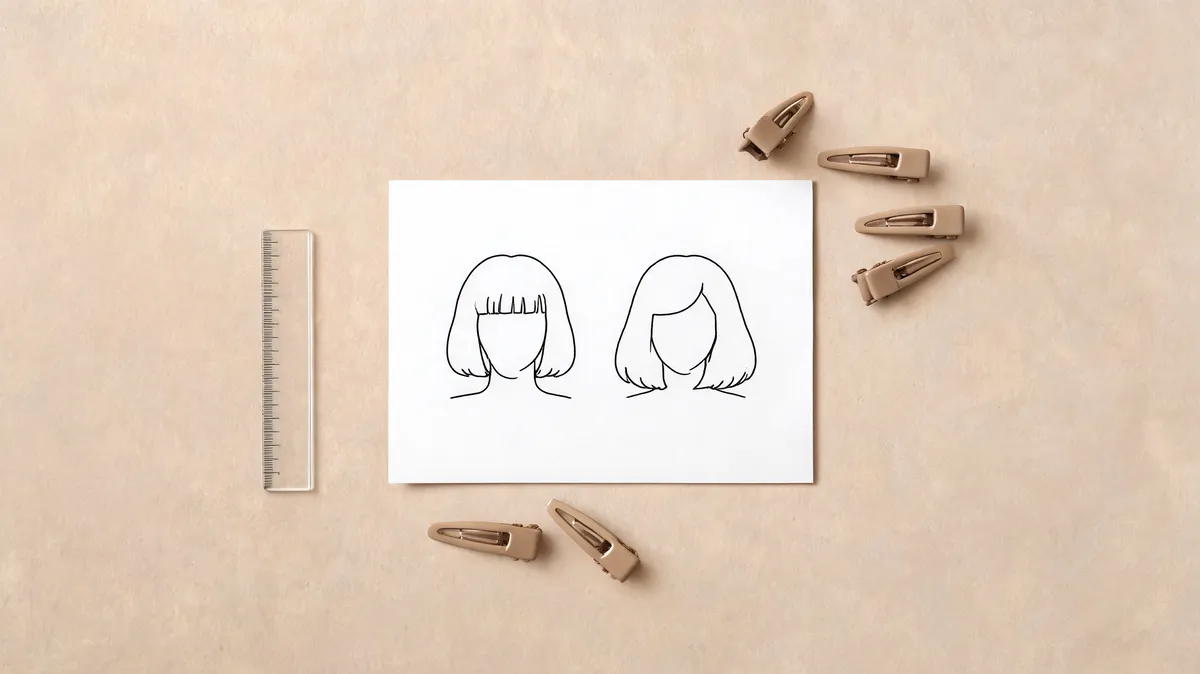
A useful reference includes a preferred direction and a practical limit, so the conversation is about your version of the bob.
Use a preview without asking it to make the haircut decision
If an image will help you find the words, make two controlled previews from the same recent selfie: one that preserves the French-bob direction you chose and one that preserves the Italian-bob direction. Keep hair color, face, light, pose, and background constant. The bob haircut filter is a focused place to start.
Then look for only the details a preview can show: where the outline appears to land, how open the face feels, whether the fringe changes your preference, and whether a fuller or lighter perimeter looks closer to you. Do not use it to estimate exact shrinkage, density, hair health, cowlicks, or how the cut will grow out.
| Preview note | What it helps you say in the chair | What the preview cannot settle |
|---|---|---|
| “I like this endpoint.” | A visible length preference to discuss dry | The exact cut length needed for your texture |
| “I want less fringe than this.” | A clear boundary around the face | Whether a fringe will split at your hairline |
| “I prefer this fuller edge.” | A preference about perimeter weight | How much internal shaping your density needs |
| “This feels too polished for me.” | A routine and finish preference | Whether your usual product and drying method will create it |
For broader hair-care or scalp questions, an image is not the right source. The American Academy of Dermatology’s everyday hair-care guidance is more appropriate, and a licensed professional can assess individual concerns.
The five non-negotiables to state before cutting
- Perimeter: Say whether you want a solid, heavier edge or a softer, more textured edge.
- Shortest point: Point to your jaw, chin, or neck area and ask how that will read when dry.
- Face framing: Choose fringe, no fringe, or longer pieces that stay open around the face.
- Internal weight: Explain whether you want light movement or a fuller shape, then ask how your texture changes that plan.
- Daily finish: Be direct about the time and heat styling you will actually use. A beautiful reference is not a commitment to recreate a blowout every morning.
There is no need to ask a stylist to copy every part of an inspiration image. Better language is: “I like this jaw-level, lightly textured outline, but I need the option to tuck it,” or “I want this fuller chin-length perimeter, with no fringe and an air-dry-friendly finish.” That communicates a priority and a constraint.
What to bring and what to ask
Bring the original photo, one or two previews, and your reference image. Avoid a large gallery of conflicting bobs. At the consultation, ask:
- Which detail in this reference will change most on my natural texture?
- What length would you start with so we can reassess it dry?
- How will the perimeter look if I air-dry rather than blow-dry?
- Can I tuck or partially tie it back at this length?
- What maintenance does this specific shape need if I want it to keep reading this way?
Editorial disclosure: AIChangeHair creates visual hairstyle previews. It does not measure hair density, diagnose scalp or hair conditions, predict shrinkage or growth, or guarantee a salon outcome. Treat any preview as a visual preference to discuss with a qualified stylist, not a cutting instruction.
Frequently asked questions
What should I tell my stylist when I want a French bob?
Describe the shortest point you are comfortable with, whether you want a fringe, how much texture you want at the perimeter, and how you normally dry your hair. Bring an image, then point to the visible details you want rather than relying on the label French bob alone.
What should I tell my stylist when I want an Italian bob?
Describe the length boundary you want, how full you want the perimeter to feel, whether you need tuck or partial tie-back options, and whether you prefer a smooth or more lived-in finish. The name is a reference, but those details make the request usable.
Should I bring an AI bob preview to a salon?
Yes, if you treat it as a conversation aid. Bring the original photo and one or two controlled previews, explain which visible parts you prefer, and let the stylist assess density, texture, growth patterns, and maintenance needs that an image cannot measure.
How do I avoid getting a bob that is shorter than I expected?
Agree on the shortest visible point before cutting starts, discuss how your natural texture changes the apparent length when dry, and ask the stylist to show the first guide length before committing. A photo should support that conversation, not replace it.
Related guides
- Try the free AI hairstyle changer →
- Bob haircut filter
- French bob vs Italian bob comparison
- AI hair preview stylist checklist
- What an AI hair preview cannot tell you
Give your stylist a direction they can adapt
Use the bob haircut filter to clarify the visible shape you prefer, then arrive with one reference, one limit, and a short description of your real routine.