
Wispy Bangs With Glasses: Preview Fringe Around Your Frames
Preview wispy bangs with glasses using your everyday frames. Compare fringe length, brow visibility and rim overlap before discussing a cut with a stylist.

Wispy bangs with glasses can work when the fringe leaves the amount of forehead, brows, and frame detail you want visible. Start with light, separated strands and compare two nearby lengths on a photo wearing your actual glasses. The AI hairstyle changer can help you inspect that balance, but a still preview cannot tell you whether hair will catch on the frames or need daily restyling.
Last updated: October 6, 2026 · about 8 min read
What makes a wispy fringe work with your frames?
The decision is about the space around your eyes, not a rule that one face shape needs one haircut. A light fringe leaves gaps between strands. Those gaps let you see some forehead and eyebrows above the glasses. You may prefer that openness, or you may enjoy a fuller fringe with a stronger frame. Neither is a correction to your appearance.
Mouqy's guide to bangs with glasses, by Allysa Gatchalian, includes thin wispy bangs among several fringe options to compare with eyewear. That helps name the look, but an inspiration photo cannot decide how it fits your own eyewear. Your frame height, natural part, front growth pattern, and willingness to style the fringe all enter the decision.
Start by asking what you want visible. Do you like seeing your whole eyebrow, just its arch, or only the top rim of the glasses? Does a small center opening feel comfortable? Those preferences give you something to compare. They are more useful than deciding that round frames always need one bang shape and rectangular frames always need another.
Which fringe details should you compare first?
Keep density fairly light while you compare length. Otherwise, you might prefer one picture because it has more visible forehead and mistakenly conclude that its length is the deciding factor. Once you choose a length direction, make a separate density comparison if needed.
| Decision | What to inspect in the preview | What to discuss in person |
|---|---|---|
| Length | Where the ends sit relative to brows and top rim | How your texture changes that length when dry |
| Separation | Whether forehead remains visible between strands | Whether your natural density supports the look |
| Center opening | Whether the bridge and inner brows remain visible | How the opening works with your part or cowlick |
| Side pieces | Whether they connect to the cut around the temples | Whether they catch when you remove your glasses |
| Frame overlap | Whether you like the visual contact with the rim | Whether hair actually touches lenses or eyes |
If you are unsure about fringe at all, the bangs filter can provide a starting preview. For this decision, keep your glasses in the photo. An attractive fringe shown without the frames does not answer how the two shapes interact when worn together.
Choose a preview because it helps you explain your preference. A picture that redraws your glasses or changes your face cannot support a useful fringe comparison.
How do you preview wispy bangs with glasses in three steps?
- Photograph your everyday frames. Wear them in their usual position and use even window light. Keep your forehead, temples, and front hair visible. Move yourself or the light slightly if a bright reflection hides your eyes; avoid tilting the frames into a position you never wear.
- Request a light fringe while preserving the glasses. Ask for separated strands near the brows, with longer sides blending into your current hair. Keep the face, frame shape, lens size, bridge, hair color, and remaining haircut unchanged. Do not add a new color or a different frame style to the same experiment.
- Compare one nearby variation. Reuse the source photo and request a slightly shorter fringe, or a small center opening. Inspect both full-size pictures before zooming in. Save the version that keeps the photo stable and gives a clear answer about brow visibility or rim overlap.
A straightforward request is enough:
Add light wispy bangs with separated strands near my eyebrows and longer sides blending into my existing hair. Keep my glasses exactly the same, including the rims, bridge, lenses, and temples. Preserve my face, expression, hair color, remaining hair length, clothing, and background.
This is suggested wording, not a tested guarantee. If a result ignores the glasses-preservation request, reject it. The best selfie for a hairstyle preview guide can help when reflections, hairline shadows, or cropping make the original photo hard to interpret.
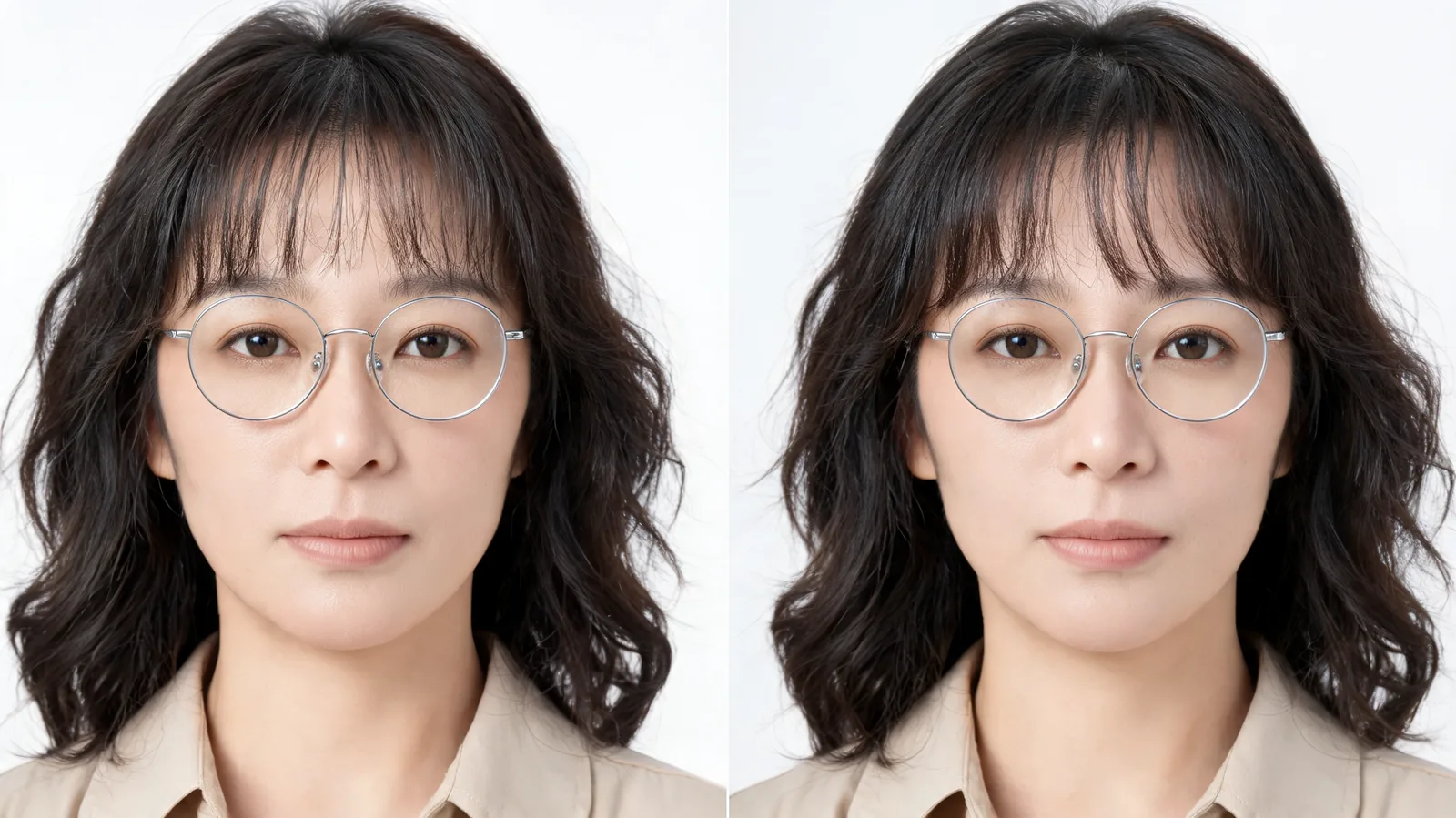 Editorial illustration: compare brow visibility and the top rim while keeping the frames consistent. The images in this guide are conceptual examples, not customer results or a prediction of comfort.
How does frame shape change what you notice?
With a thicker dark rim, you may notice the horizontal frame line before the hair. Try a fringe with enough separation to see the outline of that rim, then decide whether you like the repeated lines. You do not have to avoid a fuller look if you prefer it; the preview simply lets you compare the visual balance.
With taller lenses or oversized frames, inspect the available space above the top rim. The useful question is whether you like the amount of visible forehead and eyebrow between hair and frame. A picture can show that spacing, but it cannot establish a comfortable gap in millimeters or account for frames slipping during the day.
If you want more openness in the middle, compare the curtain bangs filter. A center opening changes the framing around the bridge and eyebrows. Keep that comparison separate from changing your glasses. You need to know whether you prefer the fringe direction with the eyewear you actually own.
Which AI mistakes should make you reject a result?
Examine the glasses before deciding that the hairstyle suits them. Follow each rim around the lens, compare the bridge with your original, and check where the arms meet the temples. A broken rim, mismatched lens size, or hair merged into the bridge is a reason to discard the image.
Also check your eyes and face outline. Reflections can make a small difference harder to interpret, especially if the source photo already hides one eye. Do not treat a clearer generated eye as proof that the new fringe is better; the result may simply have changed the photograph.
At the hairline, look for a plausible connection between the new strands and the existing roots. A fringe pasted over the forehead, abrupt empty patches, or side pieces that disappear into the frame may create an appealing silhouette without showing a credible haircut. Return to a clearer source photo before making increasingly complicated requests.
What can the picture tell you about styling and comfort?
It can show whether you prefer separated strands, an open center, or a shorter fringe above the rim. It cannot reproduce the sensation of hair brushing against your lenses, how often you push it away, or whether the sides catch when you take the glasses off. Those are everyday checks to discuss with a stylist and observe after a cut.
Tell the stylist how you wear your hair on ordinary mornings. If you usually air-dry, ask how the proposed fringe behaves without a blowout. If your front section changes direction overnight, explain that. For waves or curls, bring a photo of your usual dry texture rather than only a straightened inspiration image.
Consider the whole haircut too. A fringe can connect differently to a bob than to longer front layers. The bob haircut filter is useful if you also want to explore that outline, but do it as a later comparison. First settle the glasses-and-fringe question with the rest of your hair held steady.
When discussing styling, avoid assuming that a light fringe needs no heat or upkeep. The American Academy of Dermatology's hair-styling guidance advises care with heated tools, including low or medium settings for flat irons on dry hair. Ask about a routine you can sustain rather than selecting a cut only for its freshly styled appearance.
What should you bring to a salon appointment?
Bring your glasses, the original photo, and one or two stable previews. Include a second pair if you wear it often. Label the preference in plain language: more eyebrow visible, less density in the middle, or longer sides that move away from the rims. Your stylist needs the reason you selected the image, not an instruction to reproduce every generated strand.
Our general wispy bangs guide explains the broader fringe comparison. This frames-focused check adds a more specific decision: keep your actual glasses stable, compare the coverage around them, and let a stylist assess the practical fit.
Editorial disclosure: AIChangeHair provides visual hairstyle previews, not an eyewear fitting service or a prediction of a salon result. These comparison criteria are an editorial workflow. No comfort testing or guaranteed glasses preservation is claimed. A qualified stylist can assess your hair, and your usual eyewear professional can address frame-fit concerns.
Frequently asked questions
Do wispy bangs look good with glasses?
They can, especially if you enjoy a light fringe with visible gaps around the brows and frames. There is no universal pairing rule. Compare nearby lengths on a photo wearing your actual glasses and choose the coverage you prefer.
Should wispy bangs sit above my glasses?
A shorter fringe can leave the top rim visible, while longer pieces may overlap it. A preview can compare that appearance, but a stylist should assess the real length, texture, and whether the hair will touch your lenses or eyes.
Should I remove my glasses for a bangs preview?
Keep your everyday glasses on when the decision is about bangs with those frames. Use clear lighting with minimal lens glare, and reject results that alter the frame shape, bridge, lenses, or your face.
Can an AI preview tell me whether bangs will catch on my frames?
No. A still image cannot establish comfort, movement, or how hair catches when you remove your glasses. Bring your glasses and a stable preview to a stylist and discuss your usual dry texture and styling routine.
Related guides
- Try the AI hairstyle changer →
- Bangs filter
- Curtain bangs filter
- Bob haircut filter
- General wispy bangs preview guide
- Choosing a selfie for a hairstyle preview
Keep your frames in the decision
Use the AI hairstyle changer with your everyday glasses on. Save one stable fringe comparison and take it, your original photo, and your styling questions to a stylist.